

The cat seems like the strong point in this story. It has claws, teeth, quick reflexes, and hunting experience. But an adult rat is no mouse and not easy prey. It’s a large, wary rodent, capable of violently defending itself if confronted directly.
The phrase “can a rat attack a cat” sounds almost like a scene from a horror story. In reality, it’s more prosaic: a healthy adult cat isn’t typical prey for a rat, but a cornered or captured rodent can certainly bite back.
Rats don’t hunt cats.
For a rat, a direct confrontation with a predator is too risky. Under normal circumstances, it would rather take cover: under the floor, in a crack, behind a trash can, in a basement, or in a burrow. Escape is safer for it than a fight.
Behavior changes as the distance decreases. The cat approaches too close, tries to grab the prey, blocking the path to shelter and the rat may defend itself. This isn’t “courage” or hunting, but a defensive reaction. The bite in this situation can be swift and deep. For a cat, an encounter with a large rat sometimes ends not in a successful hunt, but in a painful injury.
When the risk is higher
One of the most likely scenarios is a confined space: a basement, a shed, a storage room, a garbage area, or an area near a burrow. In such places, it’s more difficult for animals to disperse without contact.

The risk of being bitten is higher when:
- the rat is large and adult;
- the cat is inexperienced, elderly, weak or sick;
- animals found themselves in a corner, narrow passage or closed room;
- there is a shelter or breeding ground for rodents nearby;
- The cat tries to hold the rat with its paws or grab it with its mouth.
Such a skirmish usually doesn’t last long. The rat tries to buy a few seconds to escape, and the cat may be injured before it has time to react properly.
Why an adult rat is difficult prey
Cats do catch rodents. But an adult urban rat is noticeably different from a mouse. It’s heavier, stronger, more cautious, and better at exploiting its environment: pipes, crevices, basements, tunnels, and hiding places under garbage dumps.
Cats have an easier time dealing with young, small, or weakened rats. A large adult rat is more likely to escape or bite back. A domestic cat with a hunting instinct is not a reliable way to control rats. There’s a difference between “can catch” and “should.” For a pet, such hunting poses unnecessary risks.

Why is a rat bite dangerous?
A bite wound on a cat doesn’t always look serious. Externally, it might look like one or two small punctures, a little blood, or just damp fur. Under the skin, the damage is often deeper.
When a rodent bites, bacteria from the rodent’s mouth and the surrounding environment can enter the tissue. Within hours or days, swelling, pain, lameness, inflammation, suppuration, or abscesses may develop. Bites to the face, paws, and neck are particularly unpleasant.
Cats often hide their pain. They may become quieter, move less, avoid touching, lick one spot, or suddenly become irritated when examined. This isn’t a tantrum, but a possible sign of injury.
Infections cannot be ignored
Wild rats come into contact with garbage, damp environments, waste, and other animals. Therefore, any fight with such a rodent carries a sanitary risk.
After contact, the dangers are not limited to skin punctures. Bacterial infection of the wound, abscess formation, infection through rodent saliva, and contamination of damaged tissue are possible. Some wild rodents may be associated with zoonotic infections, although the specific risk depends on the region, environmental conditions, and the condition of the animals.
Listing rare diseases without context is pointless. But a rat scratch or a cat bite is no small matter.
Why a cat doesn’t solve the rat problem
The presence of a cat can alter rat behavior. The rodents become more cautious, retreating to hiding places more often and appearing less frequently in open areas. However, this doesn’t mean that a cat can reliably control the rat population.
There’s another risk: poisoned bait. A cat could be harmed if it consumes rat repellent or catches a poisoned rodent. Therefore, any rat control measures in the house, basement, or yard must be pet-safe: bait and dead rodents should be kept out of reach.
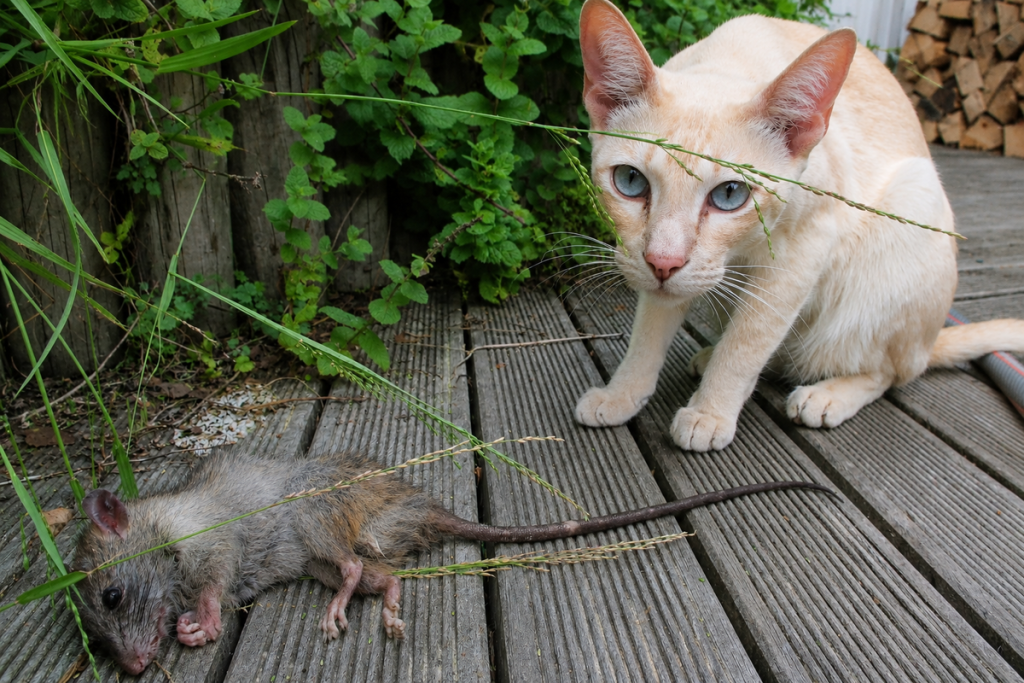
What to do if a cat encounters a rat
After encountering a rat, the cat should be examined calmly. Ideally, do this in good lighting, gently parting the fur with your fingers. Check the face, lips, ears, neck, paws, abdomen, and tail area.
Reason for contacting a veterinarian:
- blood or wet wool;
- punctures on the skin;
- swelling;
- pain when touched;
- lameness;
- lethargy;
- refusal to eat;
- frequent licking of one area;
- a sudden change in behavior.
Deep wounds should not be treated with harsh solutions or haphazardly. If a bite occurs, swelling, pain, or deterioration in health occurs, the cat should be examined. The sooner the wound is treated properly, the lower the risk of abscess formation and complications.
How to reduce the risk of a dangerous encounter
The safest solution is to avoid contact. A domestic cat should not be released into areas where rats have already been spotted. This is not beneficial hunting, but an unnecessary risk. Rats do not prey on cats, but large rats can defend themselves harshly and painfully. The main danger for a cat is not the “fight” itself, but the aftermath: skin punctures, inflammation, abscesses, infection risk, and possible poisoning from contact with rodent poisons.

